A research instrument.
Run a publishable n-of-1 mixed-methods study of yourself. A within-person structural model, a clean longitudinal dataset, and a qualitative archive — on a peer-reviewed footing.
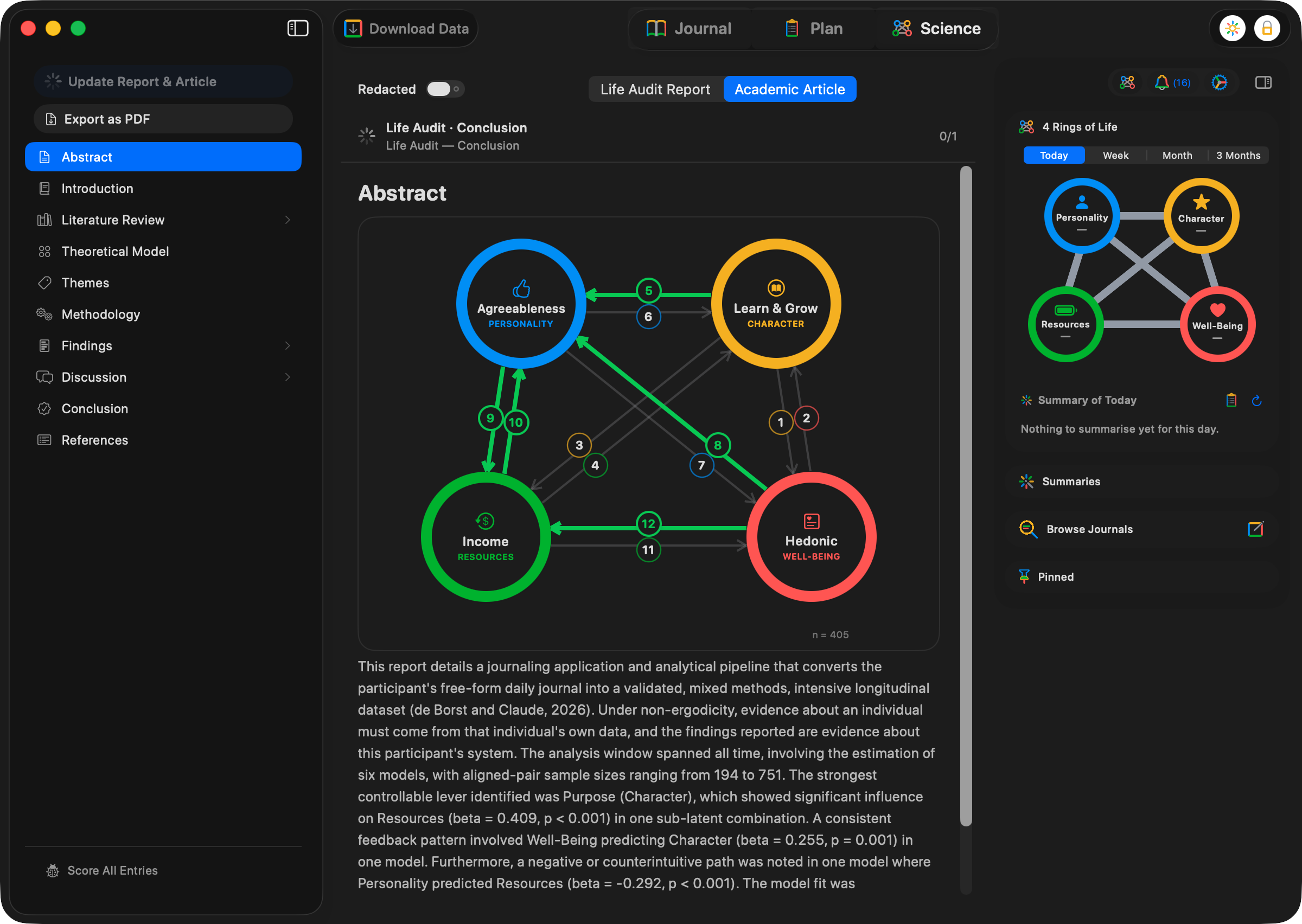
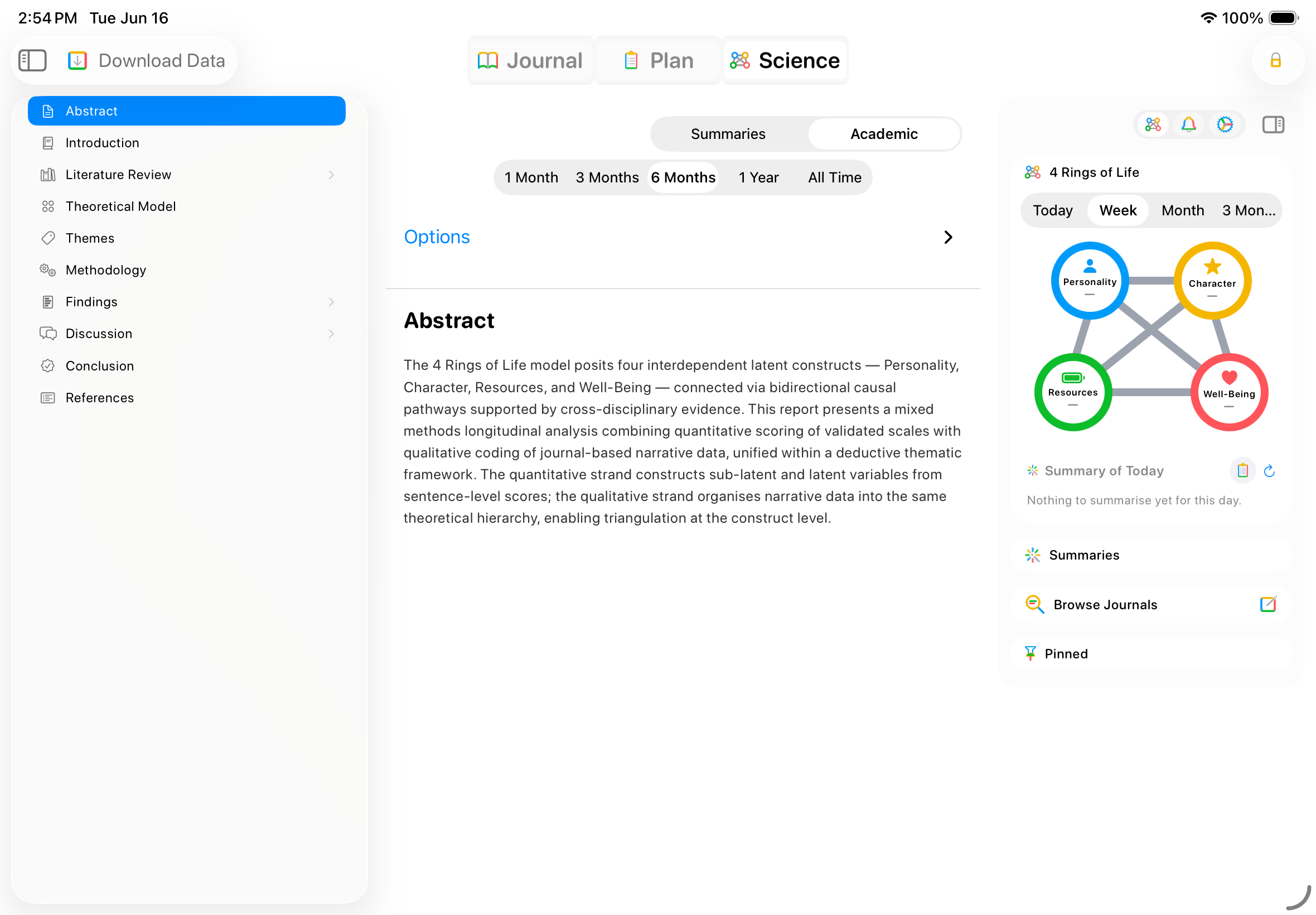
Personality — the stable trait backdrop (Big Five). The dispositional baseline against which change is measured.
Character — values, purpose, virtue. Here eudaimonia is reframed as character, in Aristotle's sense; in the model it is the strongest direct path to Well-Being.
Resources — income, health, education, and relationships, entered with diminishing returns.
Well-Being — the modelled outcome, and a feedback term that re-enters the system.
Where most well-being instruments stop at feeling good, 4 Rings asks whether you are living well. Eudaimonia is placed inside Character — virtue and practical wisdom in Aristotle's sense — rather than the values-agnostic functioning of the Ryff tradition. It is a deliberate return to the Aristotelian: eu-daimonia, a life lived well in accordance with virtue. The model's central wager — that character is the strongest path to well-being — is borne out in the worked case.
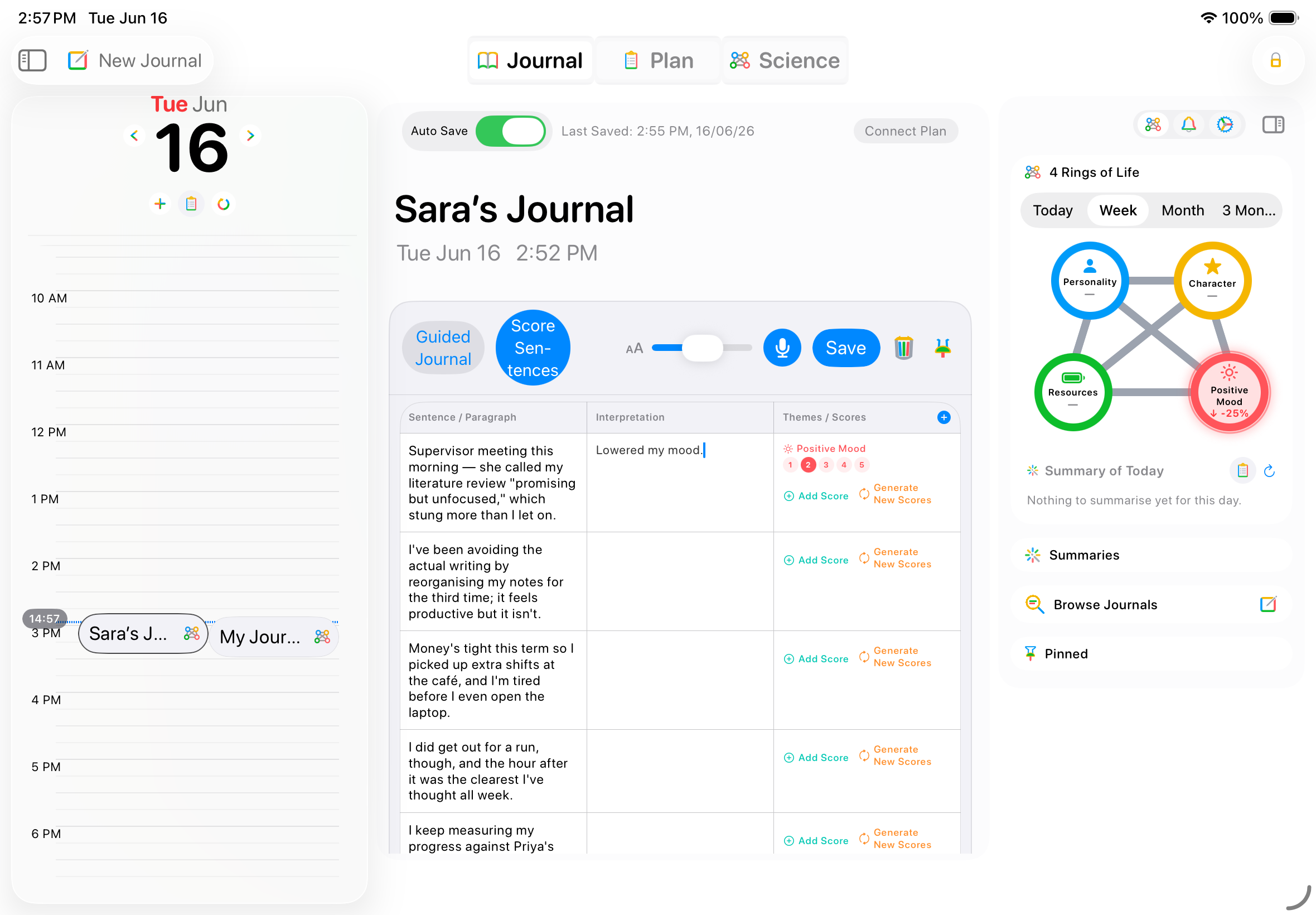
The instrument is deliberately mixed-methods. Its qualitative strand is a deductive thematic analysis: a private, on-device AI reads each sentence the participant writes, produces a written interpretation of it, and codes that interpretation to the pre-defined themes — the constructs and their facets. Its quantitative strand is the structural equation model: alongside each interpretation the model proposes a 1–5 score, which the participant confirms. Every entry therefore yields two strands at once — a qualitative archive and a quantitative dataset, an interpretation and a score for every sentence: your story and your statistics.
CSV export & Stata
Every response set exports to a flat, documented CSV: one row per observation, one column per scored item, with a codebook describing variable names, scales, and missing-value handling.
A companion Stata do-file reproduces the measurement and structural model end to end — CFA, the full SEM, and the fit statistics reported in the paper — so results can be re-estimated on your own respondents.
For your own studies
Use the validated item set as a ready-made measure of subjective well-being and its antecedents. Cite the paper, collect with the app, and re-estimate the model on your sample using the shipped do-file.
A dissertation-ready dataset
A documented instrument, a clean CSV schema, and reproducible analysis code — a defensible measurement foundation for a dissertation or thesis, whether you are a PhD or Masters candidate or a Final Year Undergraduate, with the methods already written up.
A worked SEM teaching case
A transparent, end-to-end example for quantitative methods seminars: latent constructs, measurement vs structural models, fit indices, and replication — all on a single coherent instrument.
Teaching with 4 Rings? Get in touch about module-leader access and bulk licensing.